One vocabulary for any pricing model.
OpenPricing is a provider-independent format for describing how a service is priced and packaged: features, meters, packages, rate cards, entitlements, discounts, credits. One machine-verifiable representation, whoever the provider is and however the document was produced.


What itis
One representation for pricing, whoever the provider is.
A fixed, vendor-neutral vocabulary means documents from different providers share one shape, so you reason over pricing instead of re-reading marketing pages.
A provider-independent format
One vocabulary describes features, meters, packages, rate cards, entitlements, discounts, add-ons, credits, and the conditions that qualify them. Usage, seat-based, tiered, and credit models all map to the same structure.
Machine-verifiable
A single TypeSpec-derived schema is the contract. A document is either valid against it or it is not, with no half-described or placeholder pricing in between.
Version-trackable
A document is a file. Successive versions diff cleanly, and an append-only changelog records exactly what changed in the pricing, and when.
Semantic diffs
Only genuine pricing changes register. Renamed plans and reworded copy never pollute the timeline.
Authored or extracted
A document can be written by hand or produced from a published pricing page by a validate-and-correct extraction loop. The format is the same either way.
Read it anywhere
The published JSON Schema lives at a stable URL, and the same validated catalog is served three ways: a CLI for pipelines, an MCP server for AI clients, and this static web browser. Git is the only store, and the audit log.
How itworks
From a pricing model to a document you can trust.
- 01
Author or extract
Write a document by hand against the schema, or produce one from a published pricing page: a real browser captures a dated bundle that an LLM turns into the format through a validate-and-correct loop.
- 02
Validate
Every document is checked against the single TypeSpec-derived schema. Keys are normalized deterministically, so equivalent documents stay stable instead of churning.
- 03
Version
A new version is compared to its predecessor. Only pricing-significant changes append to the changelog, and CI proves the recorded history reconciles.
- 04
Consume
Validated documents are indexed into the registry and read back through the CLI, the MCP server, the published JSON Schema, and this browser.
In thecatalog
Real providers, described in the format
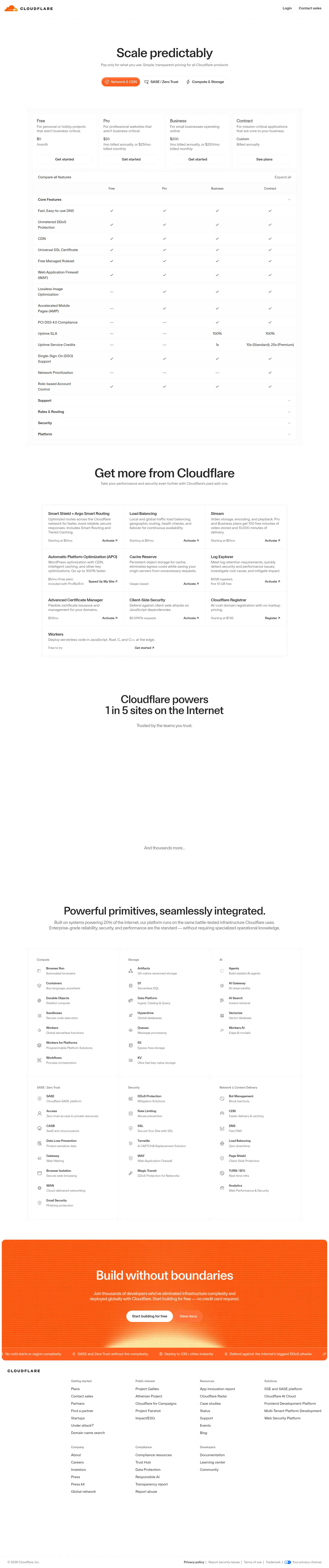
Cloudflare
Simple, transparent pricing for all Cloudflare products. Pay only for what you use.
Content deliveryFree tierPricing Model: Usage based
Packaging Model: Good / better / best
Credit Model: Proprietary credits
- packages
- 11 packages
- features
- 97 features
- meters
- 62 meters

Fly
Pay-as-you-go cloud platform for running applications globally. Pricing based on usage of compute, storage, networking, and optional add-ons.
Virtual machinesPricing Model: Usage based
Packaging Model: Single plan
Credit Model: Currency credits
- packages
- 1 packages
- features
- 24 features
- meters
- 12 meters

Railway
Pay only for what your app uses, by the second. Railway only charges you for what your app uses.
ComputeTrialPricing Model: Usage based
Packaging Model: Good / better / best
Credit Model: Currency credits
- packages
- 4 packages
- features
- 80 features
- meters
- 26 meters
Describe pricing once. Read it everywhere.
Read the specification, browse validated catalogs in the format, or fork one into a draft and design your own pricing model.